 Valley of the Kings Tour
Valley of the Kings Map: the Tombs, the Two Valleys and the West Bank
This Valley of the Kings map guide lays out the whole site on one page: the East Valley where most royal tombs sit, the quieter West Valley, the visitor centre with its electric tram, and each named tomb with its KV number and owner. It also places the rest of the Theban Necropolis on the same picture, from the Temple of Hatshepsut to Medinet Habu, so you can see what sits close together and what needs a drive. Ticket prices and entry rules live on the Valley of the Kings tickets page, and the full comparison of bookable Valley of the Kings tours stays on the homepage.
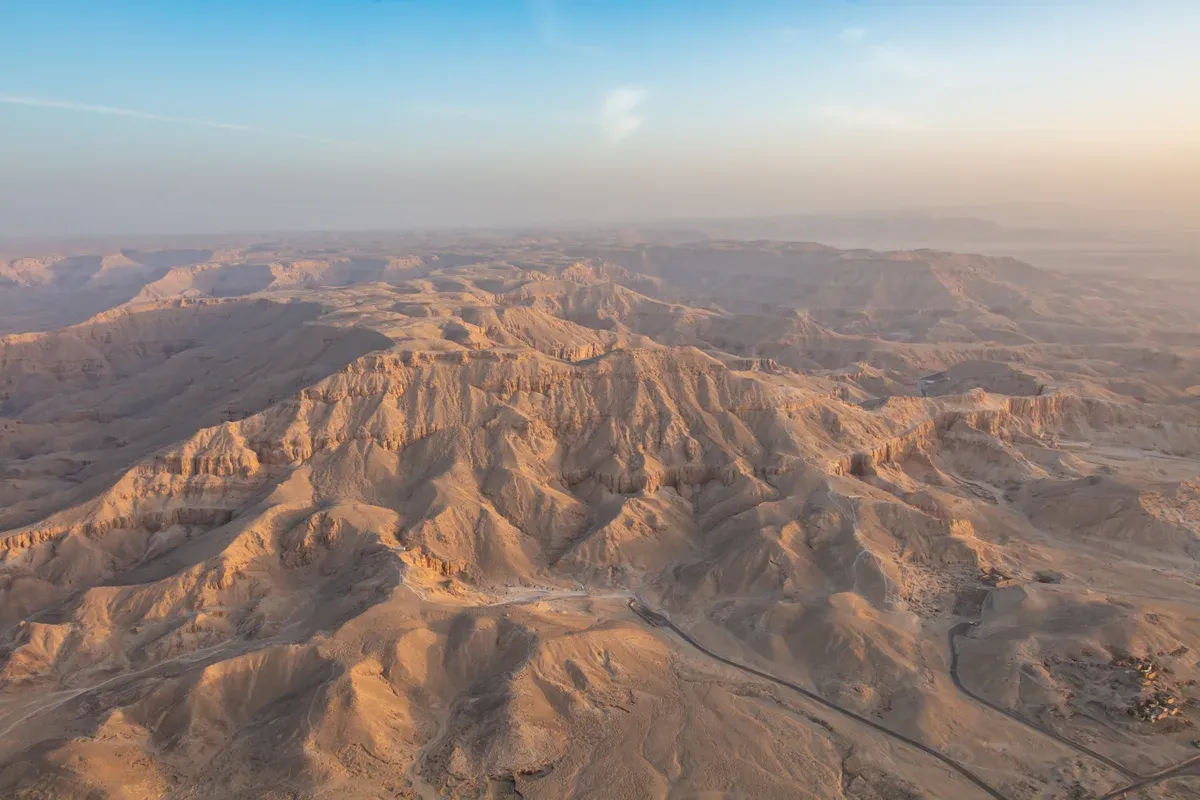
An aerial view of the desert hills and the road into the Valley of the Kings. Photo: Diego Delso, CC BY-SA 4.0, via Wikimedia Commons
Quick answer The valley at a glance
The Valley of the Kings holds 65 known tombs and chambers, and only 18 of them can be opened to visitors, rarely all at the same time. A standard ticket costs EGP 750 and covers the tombs open on the general ticket that day. The site splits into an East Valley with most royal burials and a West Valley with far fewer visitors.
Key takeaways
- The tram from the visitor centre to the tomb area takes about three minutes and costs EGP 20 round trip. See the full ticket picture.
- The tombs below each carry their KV number, owner and ticket status, starting with the main tombs one by one.
- Hatshepsut's temple sits about 570 metres from Tutankhamun's tomb in a straight line, but a cliff blocks the way. Read the West Bank map.
- Tours bundle the valley with other sites in different ways. Compare them in which tours cover which sites or on the homepage comparison table.
The Valley of the Kings and the West Bank on One Map
The royal tombs by KV number, the visitor centre and the West Bank temples, coloured by kind. A larger marker means a tour on this site goes there, and the list under the map holds the same places.
-
KV2 Ramesses IV
No tourMaximum length 88.66 metres, decorated with the Litany of Ra and Book of Caverns.
No guided tour stops here. Self-drive only.
-
KV6 Ramesses IX
No tourRuns 105 metres into the hillside, with yellow, dark blue and black in the burial chamber.
No guided tour stops here. Self-drive only.
-
KV8 Merenptah
No tourThe burial chamber lies at the end of 160 metres of corridor.
No guided tour stops here. Self-drive only.
-
KV9 Ramesses V and VI
No tourSpoil from cutting this tomb buried the entrance to KV62.
No guided tour stops here. Self-drive only.
-
KV11 Ramesses III
No tourAlso called Bruce's Tomb, 188 metres long.
No guided tour stops here. Self-drive only.
-
KV14 Twosret and Setnakhte
No tourOver 112 metres long, started for Twosret and reused by Setnakhte.
No guided tour stops here. Self-drive only.
-
KV15 Seti II
No tourSeti II had only four years to prepare it, so it was left unfinished.
No guided tour stops here. Self-drive only.
-
KV16 Ramesses I
No tourOnly 29 metres long because Ramesses I ruled under two years.
No guided tour stops here. Self-drive only.
-
KV17 Seti I
No tourBelzoni found it on 16 October 1817 and it is 137.19 metres long.
No guided tour stops here. Self-drive only.
-
KV34 Thutmose III
No tourThe first royal tomb with a cartouche-shaped burial chamber.
No guided tour stops here. Self-drive only.
-
KV35 Amenhotep II
No tourVictor Loret found it in 1898 and it later sheltered a cache of royal mummies.
No guided tour stops here. Self-drive only.
-
KV43 Thutmose IV
No tourHoward Carter discovered it in January 1903.
No guided tour stops here. Self-drive only.
-
KV47 Siptah
No tourA passageway of almost 400 feet leads to the burial chamber.
No guided tour stops here. Self-drive only.
-
KV57 Horemheb
No tourAyrton found it on 25 February 1908 for Theodore Davis.
No guided tour stops here. Self-drive only.
-
KV62 Tutankhamun
2 of the toursFour chambers and an entrance staircase, discovered 4 November 1922.
Stops here: Hurghada: Luxor Tour with Valley of the Kings & Tutankhamun, Luxor: West & East Banks & Tut's Tomb Private Full-Day Tour
-
WV23 Ay
No tourBelzoni found it in 1816 and its west wall has a marsh hunting scene with Ay and his wife Tey.
No guided tour stops here. Self-drive only.
-
WV22 Amenhotep III
No tourAbout 2 kilometres from the valley entrance and reopened on 4 October 2025.
No guided tour stops here. Self-drive only.
-
Temple of Hatshepsut
3 of the toursTerraced temple at Deir el-Bahari, 273.5 metres long.
Stops here: Luxor: Valley of the Kings and Hatshepsut Temple Day Tour, Luxor Day Tour: Valley of Kings & Queens & Hatchepsut Temples, Half-Day Luxor West Bank: Valley of Kings, Hatshepsut & Memnon
-
Colossi of Memnon
3 of the toursTwo 18 metre statues of Amenhotep III beside the road.
Stops here: Hurghada: Luxor Tour with Valley of the Kings & Tutankhamun, Luxor: Valley of the Kings and Hatshepsut Temple Day Tour, Half-Day Luxor West Bank: Valley of Kings, Hatshepsut & Memnon
-
Medinet Habu
1 of the toursMortuary temple of Ramesses III with its Sea Peoples reliefs.
Stops here: Luxor Day Tour: Valley of Kings & Queens & Hatchepsut Temples
-
Ramesseum
No tourTemple of Ramesses II covering about 10 hectares.
No guided tour stops here. Self-drive only.
-
Deir el-Medina
1 of the toursVillage of the tomb builders, about 68 houses at its peak.
Stops here: Luxor Day Tour: Valley of Kings & Queens & Hatchepsut Temples
-
Valley of the Queens
3 of the toursMain wadi holds 91 tombs and side valleys 19 more.
Stops here: Luxor Day Tour: Valley of Kings & Queens & Hatchepsut Temples, Luxor: Valley of the Kings and Queens Guided Tour with Lunch, Luxor: West & East Banks & Tut's Tomb Private Full-Day Tour
-
QV66 Nefertari
No tourFound by Schiaparelli in 1904 and restored by the Getty from 1988 to 1992.
No guided tour stops here. Self-drive only.
-
QV44 Khaemwaset
No tourTomb of a son of Ramesses III, found on 15 February 1903.
No guided tour stops here. Self-drive only.
-
QV52 Tyti
No tourTomb of Queen Tyti, wife of Ramesses III, in a Latin cross plan.
No guided tour stops here. Self-drive only.
-
QV55 Amunherkhepeshef
No tourTomb of a son of Ramesses III, found in 1904.
No guided tour stops here. Self-drive only.
-
Valley of the Kings car park (approximate)
No tourApproximate camera position of a Wikimedia Commons photo titled Parking Lot, Valley of the Kings, not a surveyed point.
No guided tour stops here. Self-drive only.
How the Valley Is Laid Out
The Valley of the Kings lies on the west bank of the Nile across from ancient Thebes, modern Luxor. Two valleys make up the site, and almost everything a visitor needs sits in the eastern one.
Two Valleys
The East Valley holds most of the royal tombs and gets nearly all the visitors. The West Valley, also called the Valley of the Monkeys, carries the WV labels and sees far fewer people. Burials here ran for about 500 years, from the Eighteenth Dynasty to the Twentieth Dynasty, roughly 1550 to 1069 BC, and Thutmose I is the first New Kingdom ruler confirmed buried in the valley.
John Gardner Wilkinson set the KV numbering used today, and Napoleon's expedition produced the first map of the valley in 1799. Royal burials here belong to the New Kingdom only.
Wikivoyage warns that flash floods can make the West Valley dangerous in rare storms, and no hiking over the mountain between the two valleys is permitted.
Visitor Centre, Tram and Walking Distances
You enter through the visitor centre, which has restrooms. An electric tram runs from the centre to the tomb area, a ride of about three minutes, at EGP 20 per person round trip. From the tram stop the tombs spread along a main road. KV2 and KV43 sit about 320 metres apart, which gives a rough sense of the length of that road.
The main cluster of tombs is tight. KV62 and KV9 are about 27 metres apart, KV62 and KV17 about 80 metres, and KV62 and KV14 about 240 metres. The West Valley is another matter. Wikivoyage describes it as a 2 kilometre walk from the main car park on a winding dirt and stone road, and WV22 lies about 2 kilometres from the valley entrance.
There are no accommodations or restaurants in the valley, only snacks, so bring water. Photography rules are disputed between sources: Wikivoyage says photography is strictly forbidden and unauthorised photos risk a second admission fee or expulsion, while other sources report that mobile phone photography is free. The site opens at 6:00 AM and closes at 5:00 PM, though some sources give 4:00 PM in winter. Budget 1 to 3 hours for the visit itself, or 5 to 6 hours if you add the separately ticketed tombs.
Sources: Ministry of Tourism and Antiquities, Wikivoyage, Wikipedia
The Tombs One by One
The KV numbers run from KV1 to KV64, set out by Wilkinson starting from the valley entrance and moving south. Here are the tombs the sources describe in detail, with their owners and ticket status.
KV34, Thutmose III
Victor Loret found KV34 in 1898. It holds one of the earliest versions of the Amduat, the text that describes the sun god's journey through the night. Wikivoyage's suggested visiting order puts it in the first group of the day, together with KV43.
Expect queues of at least 15 to 30 minutes in peak season, and remember that guides are not permitted inside the tombs, so explanations happen at the entrance.
KV17, Seti I
Seti I, who ruled about 1294 to 1279 BC and was the father of Ramesses II, is buried in KV17. Belzoni found it on 16 October 1817. The tomb runs 137.19 metres and holds seventeen chambers and side rooms.
The Ministry calls it the first tomb in the valley to be entirely decorated and the first with a vaulted burial chamber. The tomb carries a special ticket on top of the general one, and its own page has the details. Read more in the guide to the tomb of Seti I.
KV11, Ramesses III
KV11 is 188 metres long. Work began under Setnakhte, but the cut broke into the earlier tomb of Amenmesse and was abandoned. Ramesses III then extended it on a new axis.
James Bruce described it in 1768, so it is also called Bruce's Tomb, and the paintings of two blind harpers gave it the name the Harper's Tomb. It appears in the rotating set of tombs on the general ticket.
KV9, Ramesses V and Ramesses VI
KV9 is the joint tomb of Ramesses V and Ramesses VI, and it was open in antiquity. About 995 Greek, Latin, Demotic and Coptic visitor inscriptions, dated from the 1st century BC to the 4th century AD, record ancient tourists. The ceilings carry astronomical figures and the Book of the Day and the Book of the Night framed by the goddess Nut.
Spoil from digging KV9 buried the entrance to Tutankhamun's tomb under workers' huts, which helped preserve it. KV9 and KV62 sit about 27 metres apart. KV9 is one of the tombs with a special ticket.
KV62, Tutankhamun
Howard Carter discovered KV62 on 4 November 1922, and it sits about 80 metres from KV17 and about 240 metres from KV14. Entry needs a separate ticket on top of the general one, and its own page covers the price and what is actually inside. Spoil from the digging of KV9 buried its entrance, which helped preserve it.
Read more in the guide to Tutankhamun's tomb.
KV5, the Sons of Ramesses II
KV5 is the largest tomb in the valley, built for the sons of Ramesses II, with at least 130 rooms and chambers as of 2006. Kent Weeks and his Theban Mapping Project team revealed its true extent in 1995. Only about 7 percent of its chambers had been cleared as of 2006.
KV5 is closed to the public, and no ticket opens it.
KV63, the Embalming Chamber
KV63 was found on 10 March 2005 and turned out not to be a royal burial at all but a storage chamber for embalming materials, dated to about 1337 to 1334 BC. It held seven wooden coffins and 28 large storage jars filled with mummification materials.
WV22, Amenhotep III
WV22 in the West Valley holds Amenhotep III. The tomb is 85 metres long, has two subsidiary chambers for his wives Tiye and Sitamen, and lies about 2 kilometres from the valley entrance. It reopened to visitors on 4 October after restoration in three phases, 2001 to 2004, 2010 to 2012 and 2023 to 2024, by teams from Waseda University and Higashi Nippon University.
Sources disagree on how many West Valley tombs are open: Wikipedia says only one, while Wikivoyage lists both WV22 and the tomb of Ay. Confirm on the day which of them are open.
WV23, Ay
Belzoni found WV23, the tomb of Ay, in 1816, a year before he found Seti I's tomb. It sits about 960 metres from KV62 in a straight line. Wikivoyage lists it as open alongside WV22, while Wikipedia counts only one West Valley tomb open, so confirm at the ticket office.
The West Valley is a 2 kilometre walk from the main car park on a dirt and stone road, and flash floods can make it dangerous in rare storms.
The Rotating General Ticket Set
The standard EGP 750 ticket does not let you pick your tombs. The set open on it rotates and includes, at various times, KV1, KV2, KV6, KV8, KV11, KV14, KV15, KV16, KV43 and KV47, according to the Earthtrekkers guide. Some tombs close for renovation, so you cannot choose a tomb before you arrive.
Wikivoyage suggests a three-part order: Thutmose III and Thutmose IV first, then Seti I and Horemheb, then Ramesses VI and Seti II. KV17, KV9 and KV62 sit outside the general ticket and need special ones. The current prices are on the tickets page.
Sources: Wikipedia, Ministry of Tourism and Antiquities
The Best Tombs To Visit In The Valley Of The Kings? | Family Travel In Egypt
A family traveller compares which tombs in the Valley of the Kings are worth choosing. Third-party video by GoingGoing.BackBack. This site did not shoot it and has no relationship with the creator.
The Rest of the West Bank on the Map
The Valley of the Kings is one part of the Theban Necropolis, the burial ground opposite Luxor that also holds the mortuary temples and the workers' village. US News puts the valley under 5 miles from the Colossi of Memnon, Deir el-Medina, the Temple of Hatshepsut and Medinet Habu.
Temple of Hatshepsut
Hatshepsut's temple at Deir el-Bahari is the closest major sight in straight-line terms, about 570 metres from KV62, but the cliff between them is not a public route, so every visit goes around by road. Several Valley of the Kings tour listings pair the valley with the temple. Its ticket price differs between two Ministry pages, 440 EGP on the temple page and 360 EGP on the Deir el-Bahari site page.
Full details in the Temple of Hatshepsut guide.
Colossi of Memnon
The Colossi of Memnon stand about 2.3 to 2.4 kilometres from KV62 in a straight line, on the valley edge where the desert meets the fields. Nearly every tour in the comparison stops here. Details in the Colossi of Memnon guide.
Medinet Habu
Medinet Habu, the mortuary temple of Ramesses III, lies about 2.3 to 2.4 kilometres from KV62 in a straight line. Among the compared tours, only the private West Bank day covering the kings and the queens lists it, and its ticket price differs between sources. Details in the Medinet Habu guide.
The Ramesseum
The Ramesseum, the mortuary temple of Ramesses II, belongs to the same necropolis cluster as Medinet Habu and Deir el-Medina. The sources used here list it among the Theban Necropolis sites but gives no separate distance from the valley and no ticket figure, so treat it as a sight you add by road on a private itinerary rather than a measured neighbour. None of the compared tours names it as a stop.
Deir El-Medina
Deir el-Medina was the village of the workers who cut and decorated the royal tombs, and US News counts it among the sites under 5 miles from the Valley of the Kings. It appears on the private kings and queens day tour, where admission is included. No separate distance figure is published in the sources used here.
Valley of the Queens
The Valley of the Queens lies about 1.7 kilometres from KV62 in a straight line, closer to the valley than the Colossi are, though again the route goes by road. It holds the tomb of Nefertari, which has its own separate ticket. Check its current status before you plan around it.
Half-day tours such as the kings and queens half day with lunch pair the two valleys. Details in the Valley of the Queens guide.
Which Tours Cover Which Sites
Tours fold the valley into wider West Bank and Luxor days, and the figures below come from each tour's own listing. The homepage comparison table lines all of them up in one view.
Tours and the Sites They Include
The table lists each tour, the sites on its itinerary and its listed price per person. Check the entry fee note on the tour page before booking, because some prices include admission and some add it at booking or at the gate.
| Tour | Sites | Price |
|---|---|---|
| West Bank private half day | Valley of the Kings, Temple of Hatshepsut, Colossi of Memnon. Entry tickets not included | $40 |
| West Bank half day with lunch | Valley of the Kings, Hatshepsut Temple, Colossi of Memnon, lunch. Fees an optional add-on | $23 |
| Private West Bank, kings and queens | Valley of the Kings, Valley of the Queens, Hatshepsut Temple, Colossi, Medinet Habu, Deir el-Medina. Entry fees included | $89.24 |
| Balloon ride and full-day sights | Balloon flight, Valley of the Kings, Hatshepsut Temple, Colossi, Karnak. Entry fees included | $160 |
| Private both banks with Tut's tomb | Valley of the Kings with Tutankhamun's tomb, Valley of the Queens, Hatshepsut, Colossi, Karnak, Luxor Temple. Fees optional add-on | $80 |
| Hurghada day trip with Tut's tomb | Valley of the Kings, Tutankhamun's tomb, Colossi, Karnak, from Hurghada. Entry tickets included | $93 |
Sources: tour listings on the booking platforms as quoted on each tour page
Frequently Asked Questions
How many tombs are in the Valley of the Kings?
Wikipedia counts 65 tombs and chambers, about 63 of them primary burials, while the Ministry of Tourism and Antiquities describes over sixty tombs plus about twenty unfinished ones, split between the East and West valleys. Only 18 can be opened to visitors and they are rarely all open at once. The tickets page lists which ones a standard ticket covers.
Which tombs in the Valley of the Kings are open?
The general EGP 750 ticket covers a rotating set that includes KV1, KV2, KV6, KV8, KV11, KV14, KV15, KV16, KV43 and KV47 at various times. Tombs close periodically for renovation, so you cannot choose before you arrive. KV17, KV9 and KV62 need special tickets. Wikivoyage's suggested order starts with KV34, Thutmose III and KV43.
Can you walk between the tombs in the Valley of the Kings?
Yes, in the East Valley. KV62 and KV9 sit about 27 metres apart, and the whole main road from KV2 to KV43 spans roughly 320 metres. The West Valley is different: it is a 2 kilometre walk from the main car park on a dirt and stone road. The map layout section has the distances.
What is the difference between the East Valley and the West Valley?
The East Valley holds most of the royal tombs and nearly all visitors. The West Valley, also called the Valley of the Monkeys, holds the WV tombs including WV22, Amenhotep III, which reopened on 4 October. No hiking over the mountain between the two valleys is permitted, and flash floods can make the West Valley dangerous in rare storms.
How long does a visit to the Valley of the Kings take?
Earthtrekkers says plan 1 to 3 hours depending on the tombs and your pace, while We Seek Travel suggests 5 to 6 hours for a full visit that adds the separately ticketed tombs at about 1 to 2 hours per tomb. A typical tour such as the private West Bank half day allows 4 to 5 hours for the valley, Hatshepsut and the Colossi together.
Is the Valley of the Kings close to the other West Bank sites?
Yes, in straight lines. Hatshepsut's temple is about 570 metres from KV62, the Valley of the Queens about 1.7 kilometres, and the Colossi of Memnon and Medinet Habu about 2.3 to 2.4 kilometres. The cliff behind the valley blocks the direct route, so travel goes by road. See the West Bank map section.