 Valley of the Kings Tour
Karnak Temple: the Complete Visitor Guide
Karnak Temple is a vast ancient temple complex and the second most visited historical site in Egypt after the Giza pyramids. This guide covers the four precincts, the Great Hypostyle Hall with its 134 columns, the obelisks of Thutmose I and Hatshepsut, the sacred lake, the Open Air Museum and the 2.7 km Avenue of Sphinxes that runs to Luxor Temple. It also covers the tickets in Egyptian pounds, the opening hours, how long a visit takes, and how Karnak fits into a day that includes the Valley of the Kings. If you would rather join a guided day, the site compares bookable Valley of the Kings tours in one table.
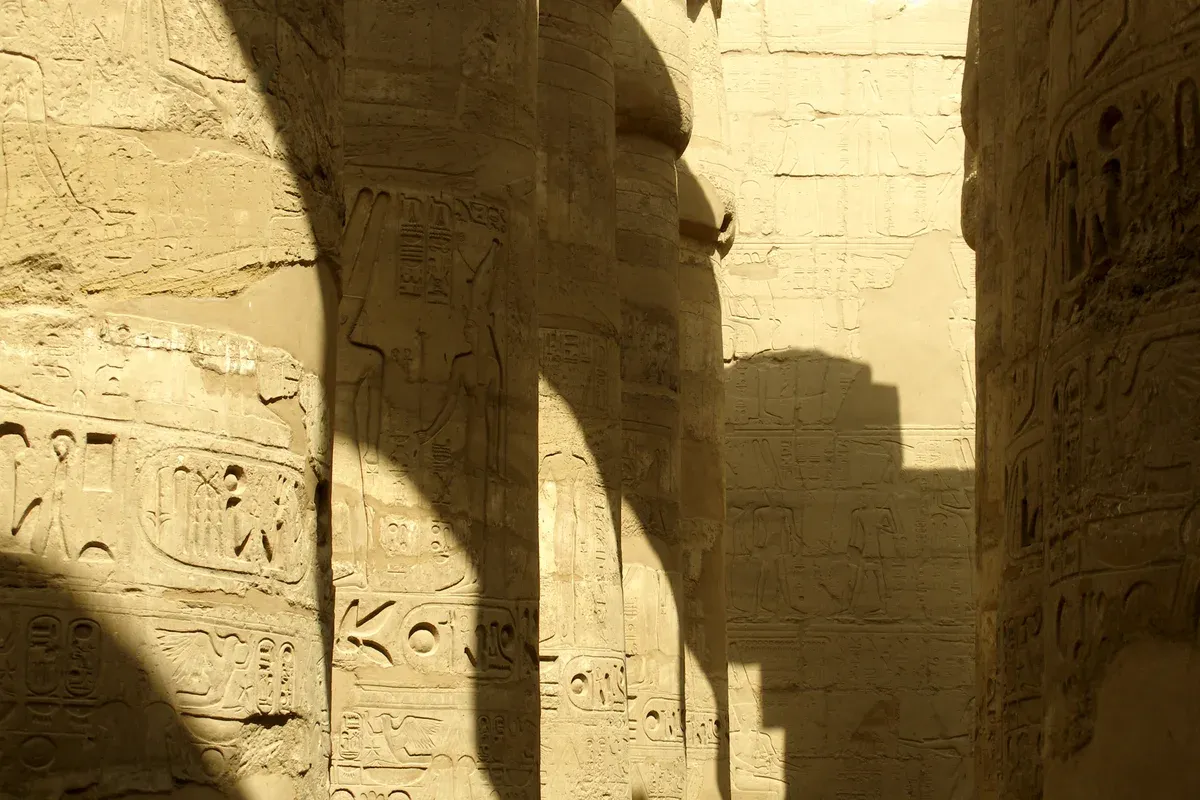
Sunlit columns and carved hieroglyphs in the Great Hypostyle Hall at Karnak. Photo: Vyacheslav Argenberg, CC BY 4.0, via Wikimedia Commons
Quick answer Karnak in brief
Karnak Temple is a vast ancient Egyptian religious complex in Luxor, built over roughly 2,000 years, with 134 columns in its Great Hypostyle Hall and a foreign adult ticket of 600 EGP. It sits on the East Bank about 3 km north of Luxor Temple. Most visitors need about one hour for a quick look and several hours for a thorough visit.
Key takeaways
- Short on time? The shared full day to both banks covers Karnak, Luxor Temple and the Valley of the Kings in 8 hours for $30, with entry fees as an option at booking.
- Doing it yourself? The official Karnak ticket is 600 EGP for foreign adults and includes the Open Air Museum. The Valley of the Kings tickets guide lists the West Bank prices too.
- Karnak and Luxor Temple are about 3 km apart and linked by the 2.7 km Avenue of Sphinxes, reopened on 25 November 2021.
- Prefer someone else to drive? See the full comparison of tours before you book.
Karnak at a Glance
The numbers below come from the Ministry of Tourism and Antiquities pages and reference sources, so you can plan a visit without guesswork.
The Key Figures
Karnak is not one temple but a city of temples. The Precinct of Amun-Re alone spans about 25 hectares, which makes it the largest of the four enclosures on the site. The hall most people come for covers 5,000 square metres. Entry, hours and walking distances are set out here.
The Ministry lists the foreign adult ticket at 600 EGP, and that ticket includes the Open Air Museum. Official prices are printed in Egyptian pounds exactly as published and are never added to a tour price. If you want the full picture of what a guided day includes, see Valley of the Kings tours from Luxor.
| Fact | Figure |
|---|---|
| Area of the Precinct of Amun-Re | about 25 hectares |
| Columns in the Great Hypostyle Hall | 134, in 16 rows |
| Height of the 12 central columns (Ministry figure, Wikipedia gives 24 m) | 21 metres |
| Foreign adult ticket | 600 EGP (includes the Open Air Museum) |
| Luxor Temple foreign adult ticket | 500 EGP |
| Opening hours (Ministry) | 6:00 AM to 5:00 PM (Wikivoyage gives 6 AM to 6 PM May to September and 6 AM to 5 PM October to April) |
| Luxor Temple hours | 6:00 AM to 8:00 PM (Wikivoyage gives 6 AM to 8 PM May to September and 6 AM to 9 PM October to April) |
| Distance to Luxor Temple | about 3 km, linked by the 2.7 km Avenue of Sphinxes |
Who Built Karnak and Over How Long
Construction at Karnak began under Senusret I, who reigned from 1971 to 1926 BCE, and the complex kept growing through the Ptolemaic period, which ended in 30 BCE. That is about 2,000 years of continuous building, though most of what you see today is New Kingdom work.
The Great Hypostyle Hall shows the sequence clearly. Seti I built it and decorated its northern half. His son Ramesses II finished the southern wing, and his carvers moved from raised relief to two phases of sunk relief, so you can compare three carving styles on the walls and columns. Later rulers added their own marks, from the Taharqa kiosk, of which a single column still stands, to the unfinished First Pylon begun in the 30th Dynasty. A visit pairs naturally with the West Bank sites, and the Temple of Hatshepsut guide covers the other great New Kingdom building project across the river.
Sources: Egyptian Ministry of Tourism and Antiquities, Wikipedia
What to See at Karnak
Work through the Amun-Re precinct along its east-west axis and you hit every highlight in order. The sights below are listed in the order most visitors meet them.
The First Pylon and the Avenue of Sphinxes
You enter through the First Pylon, an unfinished gateway 113 metres wide and 15 metres thick, begun under the 30th Dynasty and never completed. Wikipedia's Karnak article also gives its height as 43 metres, so treat that figure as approximate. The pylon was never completed.
Outside the pylon runs the start of the Avenue of Sphinxes, the processional road to Luxor Temple. The avenue originally held 1,057 statues: 807 sphinxes and 250 ram-headed figures. Building ran from the New Kingdom to Nectanebo I of the 30th Dynasty, who ruled 380 to 362 BC, after which sand buried the whole route. Excavation began in 1949 with eight statues, and the full route was mapped between 1984 and 2000 before the avenue officially reopened on 25 November 2021 after more than seven decades of work.
The Cachette Court is where Georges Legrain found more than 900 buried statues in 1903, probably hidden in the Ptolemaic period. A colossal 10.5 metre statue of Pinedjem I also stands at Karnak.
The Great Hypostyle Hall
The Great Hypostyle Hall is the reason most people come to Karnak. It covers 5,000 square metres, and its 134 columns stand in 16 rows. The 12 central columns stand about 21 metres high on the Ministry's figure (Wikipedia's Great Hypostyle Hall article gives 24 metres) and carry grilled clerestory windows that let daylight into the middle of the hall. The stone architraves bridging the columns weigh about 70 tons each.
The hall has an engineering story too. In 1899 eleven columns collapsed in a chain reaction after groundwater undermined their foundations, and Georges Legrain's restoration was completed in May 1902. Look closely at the southern wing and central columns and you can trace Ramesses II's carvers switching from raised relief to two phases of sunk relief, three styles side by side.
The Amun-Re precinct has ten pylons in total. The Festival Hall of Thutmose III stands at right angles to the main axis and holds the Karnak king list and a carved botanical garden.
The Obelisks
Two standing obelisks stand out. The first, raised by Thutmose I, is 21.2 metres high and weighs nearly 150 tons.
The second belongs to Hatshepsut and stands nearly 30 metres high, which made her twin pair the tallest in the world when erected. The survivor is the second tallest ancient obelisk on Earth. Wikipedia gives the largest obelisk in the precinct as 29 metres and 328 tons, the same monument rounded differently across articles. Her twin broke and now lies beside the sacred lake. Hatshepsut's building career at Karnak is one part of her story, and her mortuary temple across the river is covered in the Temple of Hatshepsut guide.
The Sacred Lake and the Scarab
The Sacred Lake at Karnak is crescent-shaped.
Hatshepsut's fallen obelisk lies beside the lake. The evening sound and light show ends beside the lake where tiered seating is set out. The Precinct of Mut lies about 325 metres south of the Amun-Re precinct and has its own sacred lake.
The Open Air Museum
The Open Air Museum sits in the north-west corner of the Amun-Re precinct, and the 600 EGP Karnak ticket includes it. The museum displays shrines that were rebuilt from blocks once hidden inside the pylons.
The star pieces are the White Chapel of Senusret I, the Red Chapel of Hatshepsut and the Alabaster Chapel of Amenhotep I. There is also a calcite shrine of Amenhotep II and barque shrines of Thutmose III and Thutmose IV.
The Precinct of Mut
Karnak has four main precincts: Amun-Re, Mut, Montu and the dismantled temple of Amenhotep IV. Only Amun-Re is on the standard visitor route, and the Mut precinct can be visited with its own ticket. The Ministry lists that ticket at 200 EGP.
The Mut precinct lies about 325 metres south of Amun-Re and covers roughly 9 hectares. The temple is surrounded on three sides by the horseshoe-shaped sacred lake called Isheru. Construction began under Thutmose II and Thutmose III in the 18th Dynasty, with major additions by Amenhotep III, who commissioned a forest of Sekhmet statues once estimated at about 570 granodiorite figures. Thirty now sit in the British Museum and six in the Egyptian Museum in Cairo. Margaret Benson and Janet Gourlay made the first major excavation there in 1895 to 1897, and the Brooklyn Museum worked the site from 1976 to 2001 before Johns Hopkins University took over.
Sources: Wikipedia: Great Hypostyle Hall, Wikipedia: Avenue of Sphinxes, Wikipedia: Precinct of Mut
Luxor, Egypt: The Karnak Temple Complex - Rick Steves’ Europe Travel Guide - Travel Bite
Rick Steves walks through the Karnak temple complex in Luxor. Third-party video by Rick Steves' Europe. This site did not shoot it and has no relationship with the creator.
Luxor Temple, Its Pair
Karnak never stood alone. Three kilometres south, on the same East Bank of Luxor, sits its smaller partner, and the two were built to work as one.
Who Built Luxor Temple
The core of Luxor Temple was raised by Amenhotep III around 1390 to 1352 BC. Tutankhamun and Ramesses II added sections, and Alexander the Great contributed a chapel, so the building spans many rulers in the same way Karnak does. It is built of Nubian sandstone from Gebel el-Silsila.
During the annual Opet festival, the statue of Amun was carried here from Karnak to stay with his consort Mut, and six barque shrines along the processional way served as rest stations. In Roman times the temple served as a legionary fortress and the seat of the local Roman government. Wikipedia counts over 3,400 years of religious use on the site, which was a church from 395 CE and a mosque from around 640 CE.
- Amenhotep III built the rear chapels around 1390 to 1352 BC.
- The Abu Haggag mosque, built in the 13th century, still stands inside the court of Ramesses II.
- A 2009 restoration of the mosque cost 7 million Egyptian pounds and uncovered Ramesses II inscriptions in its walls.
The Obelisk in Paris
Ramesses II set up two 25-metre obelisks at the temple gate. Muhammad Ali Pasha gave one to France in November 1830, and it was raised at Place de la Concorde in Paris in 1836. The Paris obelisk is 23 metres high, about 33.37 metres with its pedestal and cap, and a gold cap was added in 1998.
The pair was set to look equally tall even though they were not, an optical illusion you can still study on the one that remains at the gate. The Paris obelisk dates from around 1250 BC under Ramesses II.
The Avenue of Sphinxes
The two temples are linked by the Avenue of Sphinxes, 2.7 km long, officially reopened on 25 November 2021 after more than seven decades of excavation. The route originally held 1,057 statues: 807 sphinxes and 250 ram-headed figures. Three statue types line it, lion bodies with ram heads from Tutankhamun's time, full ram statues from the 18th Dynasty, and human-headed sphinxes that make up most of the line toward Luxor Temple.
Excavation began in 1949 with eight statues, and the whole route was mapped between 1984 and 2000.
| Karnak Temple | Luxor Temple |
|---|---|
| About 2,000 years of construction, Senusret I to the Ptolemies | Core by Amenhotep III, c. 1390 to 1352 BC |
| Ticket 600 EGP for foreigners, Open Air Museum included | Ticket 500 EGP for foreigners |
| Four precincts, Amun-Re open to visitors | One temple, mosque and church layers inside |
| Great Hypostyle Hall, 134 columns | Two 25-metre obelisks, one now in Paris |
Hours and Tickets for Luxor Temple
Wikivoyage lists Luxor Temple as open 6AM to 8PM from May to September and 6AM to 9PM from October to April, so it stays open later than Karnak. The foreign adult ticket is 500 EGP on the Ministry's figure. It sits about 3 km south of Karnak.
The full day that covers both temples along with the West Bank is Shared Full Day, Both Banks at $30 for 8 hours, with entry fees as an option you add at booking.
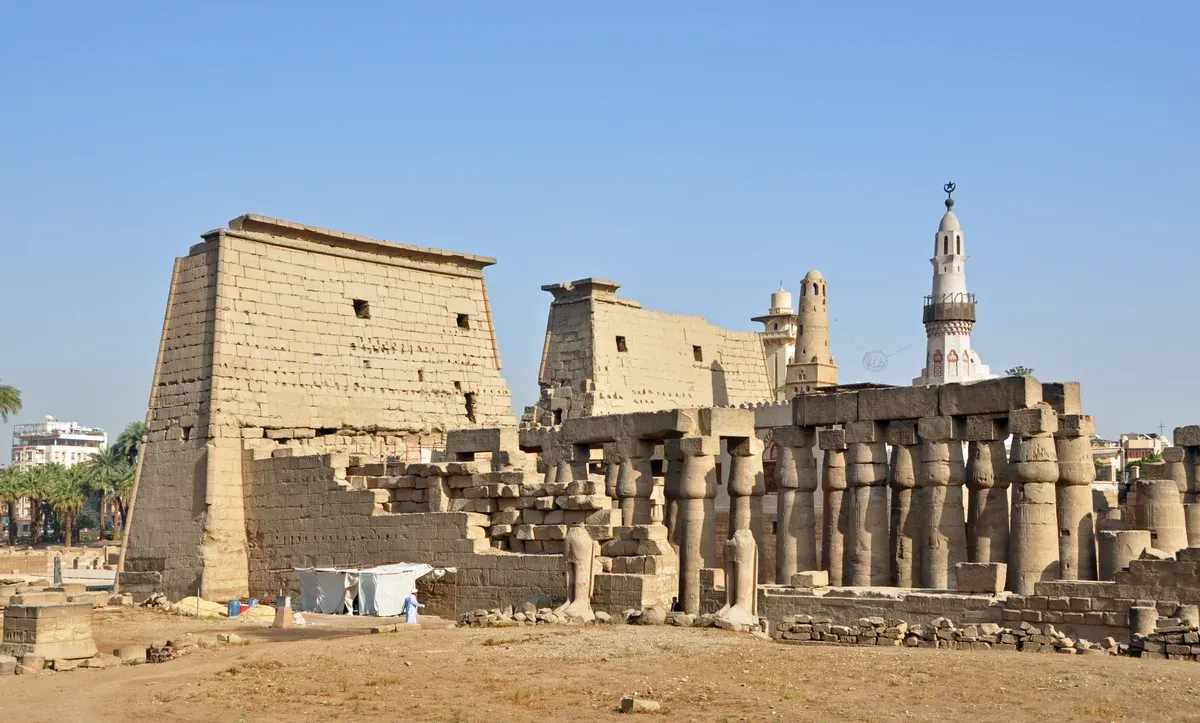
The pylon and colonnade of Luxor Temple, with the Abu al-Haggag mosque beside it. Photo: Marc Ryckaert, CC BY 3.0, via Wikimedia Commons
Planning Your Visit
Karnak rewards planning more than most sites in Luxor. The figures below come from the Ministry pages and published guides listed in the sources.
Opening Hours
The Ministry lists Karnak as open daily from 6:00 to 17:00. Wikivoyage gives longer summer hours of 6AM to 6PM from May to September and 6AM to 5PM from October to April, and a 2023 first-hand guide gives 6AM to 5:30PM, so the closing time varies by source and season. Arrive at opening either way.
Karnak is the second most visited historical site in Egypt after the Giza pyramids.
The Best Time of Day and the Heat
A 2023 first-hand guide suggests early morning as the best time to avoid the heat, and that advice fits the layout. The Amun-Re precinct spans about 25 hectares, so expect a lot of walking, and the Great Hypostyle Hall covers 5,000 square metres. Grilled clerestory windows above the central columns let daylight into the middle of the hall.
How Long a Visit Takes
The same 2023 guide suggests about one hour for a quick Karnak visit and several hours for a thorough one. A quick visit covers the First Pylon, the Hypostyle Hall, the obelisks and the Sacred Lake. A thorough visit adds the Festival Hall of Thutmose III with its carved botanical garden, the Cachette Court where Georges Legrain found more than 900 statues in 1903, and the Open Air Museum in the north-west corner.
Allow extra time if you want both the hall and the museum.
Tickets and Paying
The Ministry prices the foreign adult ticket for Karnak at 600 EGP, and that ticket includes the Open Air Museum with the White Chapel of Senusret I and the Red Chapel of Hatshepsut. The Mut precinct, 325 metres south of the Amun-Re enclosure, carries its own separate ticket of 200 EGP per the Ministry.
The Sound and Light Show
Karnak runs a sound and light show in the evening. Performance times vary by language and season, so check them locally. The show lasts about one hour including walking between stations and ends beside the Sacred Lake where tiered seating is set out.
No official dated ticket price is available, so none is printed here. Wikivoyage also notes the show can be watched from a nearby hill without a temple ticket.
Karnak and the Valley of the Kings in One Day
Most visitors to Luxor want both banks. Karnak and Luxor Temple sit on the East Bank, while the Valley of the Kings and the Temple of Hatshepsut sit on the West, and a set of bookable tours cover both in one day.
Tours That Do Both Banks
The table below lists the tours on this site that combine Karnak with the Valley of the Kings, with the price and the stated time at Karnak where the listing gives one. For the full side-by-side, see the Valley of the Kings tours comparison on the homepage. Times at Karnak are quoted only where the listing states them.
| Tour | Price | Time at Karnak | Format |
|---|---|---|---|
| Shared Full Day, Both Banks | $30 | not stated | Shared group, 8 hours, both temples plus West Bank |
| Private Both Banks with Tut's Tomb | $80 | 2 hours | Private, 8 hours, includes Tutankhamun's tomb |
| Balloon Ride and Full-Day Sights | $160 | 45 minutes | Balloon flight plus Valley of the Kings, Hatshepsut and Karnak |
| Private Car, Guide Options | $15 base | not stated | Private car, 8 hours, entry fees as an option |
What Each Tour Actually Includes
Read the inclusions before you book, because they differ sharply. The $30 shared both-banks day includes lunch but entry fees only if you select the fee option at booking. The $80 private day with Tutankhamun's tomb is the same deal on fees, but it does include the Tutankhamun tomb visit and gives 2 hours at Karnak.
The $160 balloon package includes all entry fees and the balloon ride but allows only 45 minutes at Karnak, so it is the choice if Karnak is a box to tick rather than the focus. The $15 base private car and guide is the cheapest entry point, with fees and lunch as paid options.
Coming From Hurghada
If you are based on the Red Sea coast, the Hurghada Day Trip with Tut's Tomb at $93 covers Karnak along with the Valley of the Kings, the Tutankhamun tomb and lunch, with entry tickets included and 2.5 hours at Karnak on the itinerary. It runs in a small group limited to 9 participants with hotel pickup in Hurghada, Makadi, Sahl Hasheesh, El-Gouna, Soma Bay and Safaga. More detail on the coast-to-Luxor days is on the Luxor day trip from Hurghada guide.
If you would rather see the West Bank from the air instead, read about the Luxor hot air balloon first.
Karnak and Luxor Temple FAQ
Is Luxor Temple and Karnak Temple the same?
No. Karnak is a complex of four precincts covering about 25 hectares at its largest enclosure, while Luxor Temple is a single temple about 3 km south. They were linked by the 2.7 km Avenue of Sphinxes and worked as one ritual pair. Both are covered on the Karnak Temple page and in the Valley of the Kings tours comparison.
Can you walk from Karnak to Luxor Temple?
The two temples are about 3 km apart, and the restored Avenue of Sphinxes now connects them along the whole 2.7 km route, reopened on 25 November 2021 after more than seven decades of excavation. The tours in the homepage comparison, such as the $30 Shared Full Day, Both Banks, drive between the two.
When was the Temple of Karnak built?
Construction at Karnak ran over about 2,000 years, begun under Senusret I, who reigned 1971 to 1926 BCE, and continued through the Ptolemaic period from 305 to 30 BCE. Most surviving buildings are New Kingdom, including the Great Hypostyle Hall built by Seti I and finished by Ramesses II.
How much is a ticket for Karnak Temple?
The Ministry prices the foreign adult ticket at 600 EGP, and it includes the Open Air Museum with the White Chapel of Senusret I and the Red Chapel of Hatshepsut. The separate Mut precinct ticket is 200 EGP per the Ministry. Ticket figures for the West Bank tombs are on the Valley of the Kings tickets page.
How long do you need at Karnak?
A 2023 first-hand guide suggests about one hour for a quick visit and several hours for a thorough one. The bookable tours give it between 45 minutes on the $160 Balloon Ride and Full-Day Sights and 2.5 hours on the $93 Hurghada Day Trip with Tut's Tomb.
What is the significance of the Temple of Amun-Re at Karnak?
The Precinct of Amun-Re is the largest of Karnak's four enclosures at about 25 hectares, with ten pylons and the 5,000-square-metre Great Hypostyle Hall. It was linked to the god Amun, whose statue travelled the Avenue of Sphinxes to Luxor Temple during the Opet festival. Only the Amun-Re precinct, plus the Mut precinct with its own ticket, is open to ordinary visitors.
Is Luxor Temple open in the evening?
Yes. Wikivoyage lists Luxor Temple as open 6AM to 8PM from May to September and 6AM to 9PM from October to April, making it the better after-dark visit of the two East Bank temples. The foreign adult ticket is 500 EGP, and the site has been in religious use for over 3,400 years, with the Abu Haggag mosque still inside the court of Ramesses II.