 Valley of the Kings Tour
The Tomb of Seti I (KV17)
The tomb of Seti I, numbered KV17, is a tomb in the Valley of the Kings that the Ministry of Tourism and Antiquities calls the first to be entirely decorated. It sits apart from the tombs on the standard ticket, so most visitors weigh a separate ticket against the depth of what they get: more than 137 metres of painted corridors, a vaulted burial chamber with golden stars, and wall scenes from some of the great Egyptian funerary books. This guide covers the tomb itself, the ticket, the tunnel and what a Valley of the Kings tour does and does not include when Seti I is on your list.
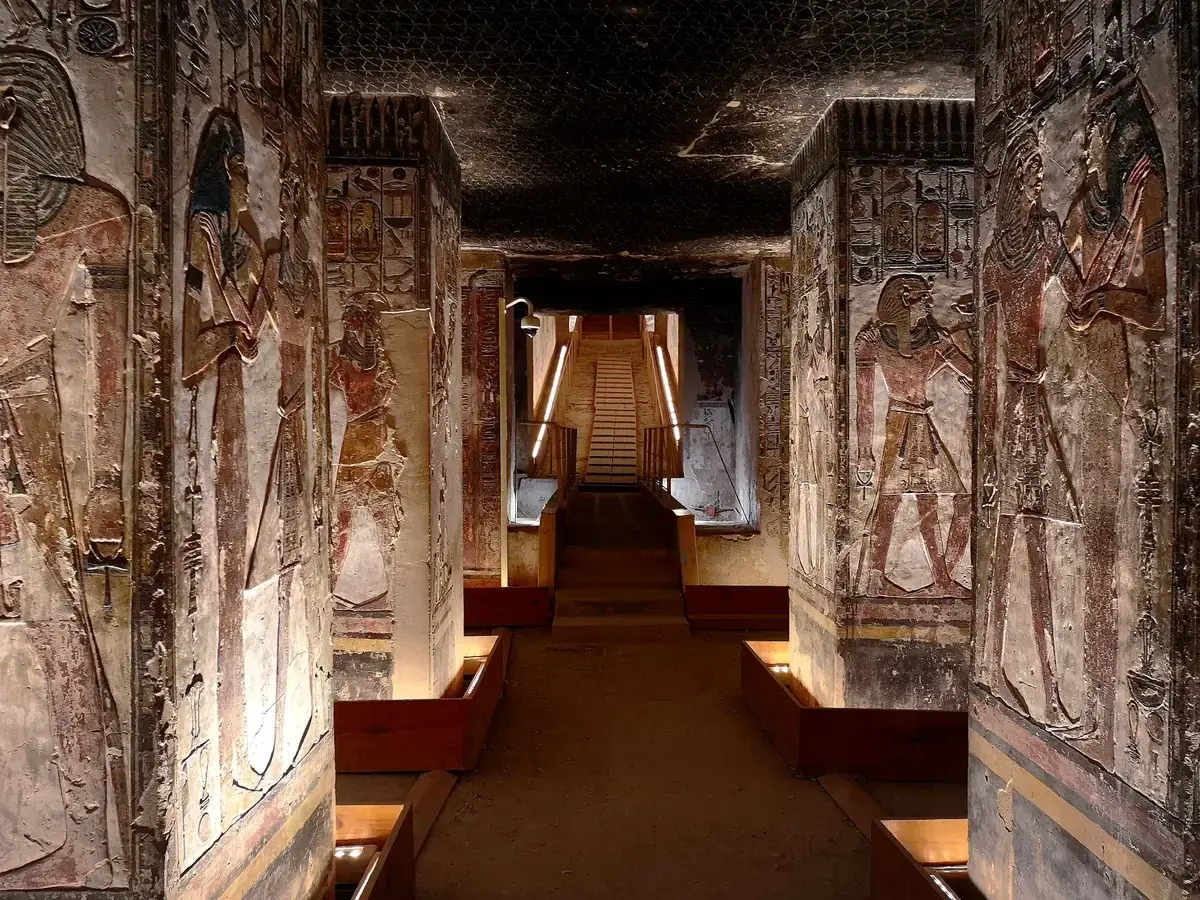
The painted corridor and pillared chamber inside the tomb of Seti I, KV17. Photo: Carole Raddato from Frankfurt, Germany, CC BY-SA 2.0, via Wikimedia Commons
Quick answer KV17 at a glance
KV17 is the tomb of Seti I in the Valley of the Kings, 137.19 metres long with seventeen chambers, and it needs a special ticket of EGP 2,000 on top of the standard entry ticket.
Key takeaways
- The full ticket picture, including the standard EGP 750 ticket, is on the Valley of the Kings tickets page.
- No listing on this site names the Seti I ticket as included. Compare the listings in the comparison table.
- See how KV17 relates to the other open tombs on the Valley of the Kings map.
A Fully Decorated Tomb in the Valley
KV17 was long thought the longest tomb in the Valley of the Kings, and Giovanni Belzoni found it in 1817.
Who Seti I Was
Seti I ruled Egypt from about 1294 to 1279 BC and was the father of Ramesses II. The Ministry of Tourism and Antiquities credits KV17 as the first tomb in the valley to be entirely decorated and the first with a vaulted burial chamber. The design follows a joggled axis, with four entry hallways labelled A to D leading further underground.
Chamber E has a well shaft cut into the floor, as in many early tombs in the valley.
Belzoni and the Discovery
The explorer Giovanni Belzoni found KV17 on 16 October 1817. According to his account, the paint on the walls still looked fresh, and some of the ancient artists' paints and brushes were still lying on the floor. The tomb was later called Belzoni's tomb after him, and it also picked up the names Tomb of Apis and Tomb of Psammis, son of Nechois.
The Apis name came from a mummified Apis bull found in a side room off the burial hall. Belzoni's treatment of his discovery was rough by modern standards. He took wax and plaster squeezes of the reliefs that pulled colour from the walls, hacked off large pieces of relief to send to Europe, and cleared rubble that had held back flash floods.
After the rubble went, KV17 flooded, and the reliefs in the entryway were damaged. Visits to KV17 have been restricted at times because of excavation damage and unregulated tourism, but Wikipedia says the tomb was open to visitors as of 2025.
Size and Layout
KV17 is 137.19 metres long, with seventeen chambers and side rooms. For a long time it was thought to be the longest tomb in the valley, and it kept that title until KV5 was explored. The decoration is not concentrated in one show room.
Reliefs survive in all but two of the seventeen chambers and side rooms, and the pillared rooms F, Fa, J, Jb, Jc and Jd all carry carved pillars with well preserved decoration. Corridors B to D are heavily decorated with symbols of the pharaoh, including the goddess Ma'at and a long list of Seti's royal names and epithets. To plan your time around KV17 and the tombs on the standard ticket, the Valley of the Kings map lays out which tomb is where.
Sources: Ministry of Tourism and Antiquities, Valley of the Kings, Wikipedia
What the Walls Show
KV17 carries scenes from several major funerary texts, and its reliefs are well preserved in most chambers.
The Books on the Walls
The corridors and chambers of KV17 carry scenes from several major funerary compositions. The entry corridors hold symbols of the pharaoh and his titles. Deeper in, the walls show the Litany of Ra, the Book of the Dead, the Imydwat, also called the Amduat, in side chamber Jb, and the Book of the Heavenly Cow.
Chamber F shows Seti with Hathor, Horus and Neith beside intact scenes from the Book of Gates. A back chamber carries a semi-complete Opening of the Mouth ceremony. The ceiling of the vaulted burial chamber shows astronomical motifs with golden stars scattered on a deep blue background.
Because guides are not permitted to lecture inside the tombs, explanations happen outside the entrance, so it is worth reading up on these texts before you go down.
The Sarcophagus, the Mummy and the Tunnel
Seti I's outer sarcophagus is not in Egypt. It has been displayed in Sir John Soane's Museum in London since 1824. Belzoni first offered it to the British Museum, and it was then sold to the architect Sir John Soane, with the sale dated 1817 by some sources and 1824 by others.
The mummy was not in KV17 either when Belzoni arrived. It was found in the royal cache DB320 with 36 other mummies, after being moved in Year 11 of Shoshenq I. Below the spot where the sarcophagus stood, corridor K is a tunnel sloping down into the bedrock. A 1960 attempt cleared nearly 136 metres before it was abandoned for safety because of poor rock.
From 2007 to 2010 the Supreme Council of Antiquities reopened the tunnel with steel supports and a debris railway, and found that it ends abruptly at the bottom of a second staircase, 174 metres in total. If you cannot visit in person, a 3D scan of KV17 has been available since 2002, and the Factum Foundation made full facsimiles of the Hall of Beauties and Pillared Hall J in 2017.
INSIDE the Greatest Egyptian Tomb! SETI I (the Valley of the Kings)
A walk inside the tomb of Seti I showing its painted corridors and burial chamber. Third-party video by Ancient Sites Girl. This site did not shoot it and has no relationship with the creator.
Visiting KV17
KV17 needs its own ticket, and the practical details around it matter because the figures come from different sources.
Ticket, Hours and Rules
The figures below come from the Ministry of Tourism and Antiquities and published visitor sources. The Seti I ticket sits outside the standard Valley of the Kings ticket, and the full breakdown of both is on the tickets page.
| Item | Detail |
|---|---|
| KV17 ticket | EGP 2,000, a special ticket outside the standard ticket |
| Standard valley ticket | EGP 750, covers the included tombs only, not Seti I |
| Student rule | Not stated for KV17 |
| Luxor Pass Premium | Covers the tomb of Seti I |
| Opening hours | The valley opens at 6:00 AM and closes at 5:00 PM, with some sources giving 4:00 PM in winter |
| Photography | One source says photography is strictly forbidden, others say mobile phone photography is free |
| Getting to the tombs | An electric tram runs from the visitor centre to the tomb area, about three minutes, at EGP 20 round trip |
Booking a Tour That Covers It
No listing on this site names the Seti I ticket as included. The honest route is to buy the EGP 2,000 ticket yourself at the gate and pair it with a guided visit to the valley. The Private Valley of the Kings, 4 Hours tour costs $50 with an Egyptologist guide and hotel transfers, and its listing quotes entrance tickets at EGP 1,900 per person in the special instructions and 750 EGP in the exclusions, so treat those two amounts with care and expect to pay the special ticket on top.
For a wider day, the Private West Bank, Kings and Queens tour costs $89.24 over 8 hours and includes admission to the Valley of the Kings, the Valley of the Queens, Deir el-Medina, Medinet Habu and Hatshepsut Temple. The listing does not mention Seti I. The full tour-by-tour breakdown is in the Valley of the Kings tours comparison. Guides are not allowed to lecture inside any tomb, so plan questions for outside the entrance.
Wikivoyage suggests pairing Seti I with Horemheb, KV57, as one group of tombs if you are splitting the valley across a day.
Queues, Trams and How the Visit Flows
Getting to KV17 and standing in line take time, and the rules inside the tomb shape the visit as much as the art does.
The Tram and the Walk to the Door
An electric tram runs from the visitor centre to the tomb area, a ride of about three minutes. The round trip costs 20 EGP per person, a figure listed by Earthtrekkers, We Seek Travel and Wikivoyage. The visitor centre has restrooms, so sort that out before you head down the valley. A tour such as Private Valley of the Kings, 4 Hours covers the transfer and the ticket queue at $50.
Expect a queue of at least 15 to 30 minutes in peak season, per Wikivoyage. Visitors move in single file inside the tombs to keep the crowd flowing, so there is no lingering in front of a scene you like.
Guides Stay Outside
Guides are not permitted inside the tombs, according to Earthtrekkers. We Seek Travel explains the same rule from the other side: guides cannot lecture inside, so explanations happen at the entrance or at rest areas. Read up on the tomb before you enter, because once you pass the door you are on your own with the walls.
Plan on 1 to 2 hours per tomb if you combine the standard tombs with paid ones like KV17, or 5 to 6 hours for a full visit of the valley. For a wider day that fits the valley around other sites, Balloon Ride and Full-Day Sights includes entry fees and the balloon for $160. See the Valley of the Kings tours homepage for the full spread, or start from the guide to planning a Valley of the Kings tours.
What the Tomb Lost and Where to See It Again
KV17 lost pieces once excavators and visitors arrived.
The Toll of Excavation
Belzoni took wax and plaster squeezes of the reliefs, which pulled colour from the walls, and he hacked off large pieces to send to Europe. He also cleared rubble that had held back flash floods, after which the tomb flooded and damaged the entryway reliefs. Champollion removed a wall panel measuring 2.26 by 1.05 metres from a corridor in 1828 and 1829.
Pieces taken by Champollion, Rosellini and Lepsius now sit in the Louvre, Florence and Berlin. Excavations in the late 1950s and early 1960s changed the moisture in the rock and caused walls to collapse or crack.
Seeing the Painted Rooms Another Way
Not everything is lost or behind a ticket. A 3D scan of KV17 was made available in 2002, letting viewers walk through the tomb online. In 2017 the Factum Foundation made facsimiles of the Hall of Beauties and Pillared Hall J, two of the most painted rooms.
The tunnel story runs the same way. A first attempt in 1960 cleared nearly 136 metres before poor rock stopped it. From 2007 to 2010 the Supreme Council of Antiquities reopened the corridor with steel supports and a debris railway, and found it ends abruptly at the bottom of a second staircase at 174 metres in total.
Tomb of Seti I: Questions
Is the tomb of Seti I worth the extra ticket?
It is a fully decorated tomb, 137.19 metres long with scenes from the Book of Gates and a star-filled ceiling, and it costs a special ticket of EGP 2,000 beyond the standard EGP 750 ticket. The full cost breakdown is on the tickets page.
Do tours include the Seti I tomb ticket?
No listing on this site names it as included. Entry tickets are included on some tours and sold as options on others. Compare what each tour covers in the comparison table.
Where was Seti I's mummy found?
Not in KV17. His mummy was found in the royal cache DB320 with 36 other mummies, after it was moved in Year 11 of Shoshenq I. The outer sarcophagus went the other way, to Sir John Soane's Museum in London.
How long is KV17 and how much time should I allow?
The tomb is 137.19 metres long with seventeen chambers and side rooms. We Seek Travel suggests 1 to 2 hours per tomb, and Wikivoyage says to expect a queue of at least 15 to 30 minutes in peak season. The Valley of the Kings map helps you plan the rest of the valley around it.
Can I visit KV17 without a guide?
Yes, you can buy the special ticket at the gate yourself, and guides are not permitted to lecture inside the tombs anyway. If you want a guide for the valley as a whole, the private 4-hour tour at $50 is the closest match, listed under Valley of the Kings tours.