 Valley of the Kings Tour
The Valley of the Queens: Who Is Buried There and What a Ticket Buys
The Valley of the Queens sits on the Luxor West Bank, near the better known Valley of the Kings. It holds 110 documented tombs, and its showpiece is QV66, the tomb of Queen Nefertari. This guide covers who was buried here, what the general ticket and the separate Nefertari ticket cost, which tombs you can actually enter, and how the valley differs from the kings next door. It also lists the bookable tours that stop here alongside the Valley of the Kings, so you can decide whether to come on a guided day or on your own. If you are still planning the wider West Bank, the Valley of the Kings tours comparison covers the full range of options from Luxor.
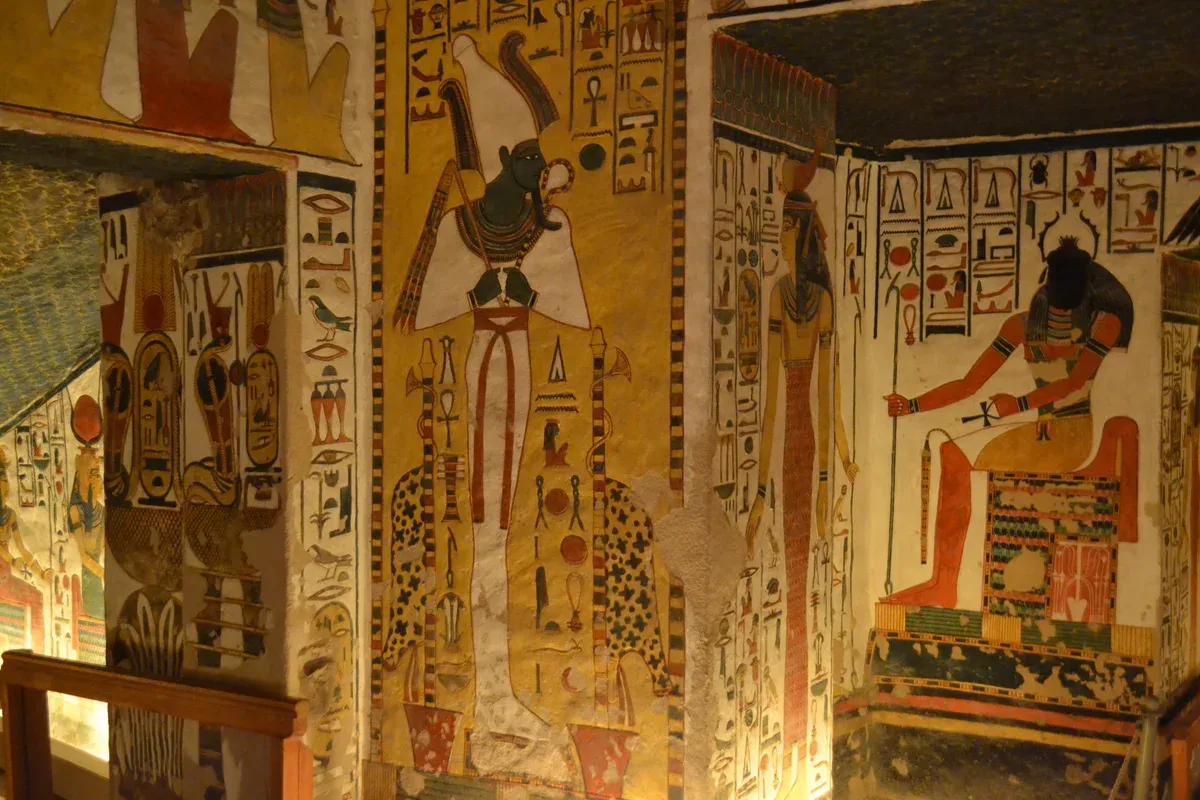
Osiris, Khepri and Nefertari painted on a wall of Nefertari's tomb in the Valley of the Queens. Photo: Darer101, CC BY-SA 4.0, via Wikimedia Commons
Quick answer Valley of the Queens at a glance
The Valley of the Queens is a burial ground on the Luxor West Bank with 110 documented tombs. A general ticket costs EGP 220 and covers three available tombs. Nefertari's tomb QV66 needs its own ticket, listed at 2,000 EGP by some sources and LE2500 by Wikivoyage.
Key takeaways
- The general ticket at EGP 220 covers three available tombs. Nefertari's QV66 is not part of it and needs its own ticket. See the other tombs in the valley.
- QV66 was found by Schiaparelli in 1904 and restored by the Getty Conservation Institute between 1988 and April 1992. Access has changed several times, so check before going. Read the Tomb of Nefertari.
- The valley holds queens and, under Ramesses III, royal princes such as Khaemwaset in QV44 and Amun-her-khepeshef in QV55. See who was buried here.
- For the kings next door, tickets and tomb rules sit on the Valley of the Kings tickets page.
Who Was Buried in the Valley of the Queens
The valley served the royal women and children of the New Kingdom for more than four centuries, and its ancient name says as much about its purpose as its tombs do.
Queens, Princes and the Place of Beauty
The Egyptians called the valley Ta-Set-Neferu, the Place of Beauty, a name that can also mean the Place of the Royal Children. Burials here run from roughly 1560 BC to 1130 BC, The count stands at 110 documented tombs, with 91 in the main wadi and 19 in the side valleys.
The best known occupant is Nefertari, the Great Royal Wife of Ramesses II, whose tomb QV66 dates to about 1290 to 1224 BC. Under Ramesses III the valley received tombs for his wives, for royal sons, which was unusual. The Turin Papyrus mentions six tombs prepared under Ramesses VI. The first tomb of the Nineteenth Dynasty was likely QV38, that of Queen Satre, started under Ramesses I and finished under Seti I.
A sacred grotto of Hathor at the valley entrance may have been one reason the site was chosen, and the nearby workers' village of Deir el-Medina another. That village housed the tomb builders in about 68 houses at its final form, and its workers staged what may be the first recorded sit-down strike around 1170 BC, under Ramesses III, over late grain rations.
Side Valleys, Rock and Preservation
The main wadi is not the whole site. The valley also takes in the Valley of Prince Ahmose, the Valley of the Rope, the Valley of the Three Pits and the Valley of the Dolmen. Every burial in these side valleys dates to the Eighteenth Dynasty, the earlier stretch of the New Kingdom.
The ground itself works against the paintings. The valley sits on limestone, marl, clay, chalk and shale, and salt from halite in the ground, together with seeping groundwater, damages the tomb walls. That geology is a large part of why the painted tombs need constant monitoring, and why visitor controls now include walled paths, shelters at popular tombs such as QV66, plexiglass shields and wooden floors.
The valley was inscribed with Ancient Thebes as a World Heritage site in 1979. Ernesto Schiaparelli and Francesco Ballerini led the early excavations in the early 1900s. Some chambers are left alone entirely: the bat colonies in QV15, QV48 and QV78 are deliberately left undisturbed for ecological reasons.
Sources: Ministry of Tourism and Antiquities, Valley of the Kings, Wikipedia
The Tomb of Nefertari, QV66
QV66 is the reason many visitors come to the valley at all, and also the reason many leave disappointed, because access to it has never been simple.
The Find in 1904
Schiaparelli discovered the tomb of Nefertari in 1904, and his team found the staircase on his second campaign. The staircase is 1.65 metres wide and descends 8 metres to a doorway. The tomb was found open and looted, so the burial itself was largely gone.
What Schiaparelli recovered tells the story of that loss: only the queen's legs, her palm-fibre sandals, about thirty ushabti figures and fragments of the pink granite sarcophagus. The leg remains are now in the Museo Egizio in Turin. The walls, by contrast, largely survived, and they are what make the tomb famous.
The Paintings and the Getty Restoration
The tomb covers 520 square metres, a figure Earthtrekkers gives, and about two thirds of its 5,200 square feet of wall paintings survive. The antechamber is painted with Chapter 17 of the Book of the Dead under a dark blue ceiling of golden five-pointed stars. One famous wall shows Nefertari playing senet. The burial chamber covers about 90 square metres, has an astronomical ceiling held up by four fully decorated pillars, and was called the golden hall. The walls name gods including Isis, Osiris, Anubis, Hathor, Neith, Serket and Thoth.
The paintings nearly did not make it. Water damage, bacterial growth, salt formation and even visitors' breath all took their toll. The tomb was closed to the public in 1950. The Getty Conservation Institute and Egypt's Antiquities Organisation began the project in 1986, the work itself ran from 1988 to April 1992, and the Getty still monitors the tomb regularly.
The Ticket, the Time Limit and Access Today
QV66 is not part of the general valley ticket. It needs a separate ticket, and the reported figures differ: 2,000 EGP per Wikipedia and Earthtrekkers, against LE2500 per Wikivoyage. Earthtrekkers gives a time limit of 10 minutes inside the tomb.
Access has a long record of change. After the Getty work the tomb reopened with 150 visitors at a time, then was restricted again in 2006 to private tours of up to 20 people paying US$3,000. Since then the status has changed more than once and sources disagree. Confirm the current situation before you plan a trip around QV66, and do not build a whole day on the assumption that you can enter.
Is Nefertari's Tomb Worth It? Look Inside Luxor’s $100 Tomb at the Valley of the Queens
A look inside Nefertari's tomb at the Valley of the Queens and whether its high ticket price is justified. Third-party video by Egypt Adventures Travel. This site did not shoot it and has no relationship with the creator.
Other Tombs in the Valley
The general ticket at EGP 220 covers three available tombs. The sources do not say which three, so these are documented tombs of the valley from the reign of Ramesses III and his family.
QV44, the Tomb of Prince Khaemwaset
QV44 belonged to Prince Khaemwaset, a son of Ramesses III, and was discovered on 15 February 1903 during Schiaparelli's first campaign. The reliefs show Ramesses III before Ptah, Thoth, Anubis and Ra-Harakhty, and the side rooms show the Sons of Horus with Isis, Nephthys, Neith and Serqet. More than forty wooden sarcophagi of the 25th to 26th Dynasty were found inside, clear evidence that the tomb was reused and ransacked long after the prince's burial.
QV55, the Tomb of Prince Amun-her-khepeshef
QV55 belonged to Prince Amun-her-khepeshef, another son of Ramesses III, and was found by Schiaparelli in 1904. The antechamber shows the king with his son, once in the company of Isis and once of Hathor. A pink granite sarcophagus remains in the rear chamber, which is a rare survivor of the original burial equipment.
QV52, the Tomb of Queen Tyti
QV52 belongs to Queen Tyti, a wife of Ramesses III and mother of Ramesses IV. The tomb has a Latin cross plan, and its decoration shows the queen's journey through the Duat, the Egyptian underworld. It has a long modern history: it was accessible from the early nineteenth century, with Jean-Jacques Rifaud recorded as its first visitor, and it was excavated in 1903 and 1904.
Thirty-four granite sarcophagus fragments were found there.
Kings or Queens, or Both
The two valleys sit close together on the West Bank and most visitors can fit both in one day.
How the Two Valleys Differ
The Valley of the Kings is the headline site, with special tickets for the big names such as Seti I and Tutankhamun, covered in detail on the Valley of the Kings tickets page and the Valley of the Kings map. The Valley of the Queens is described as quieter in the tour listings, and its one superstar, Nefertari's tomb, is priced and ticketed separately from everything else. The table sums up the differences using the figures in this guide.
If you want to see Tutankhamun's actual burial, read the Tutankhamun's tomb guide, and for the tomb of Seti I, see the tomb of Seti I page.
| Feature | Valley of the Kings | Valley of the Queens |
|---|---|---|
| Documented tombs | See the map page | 110 tombs, 91 in the main wadi |
| General ticket | See the tickets page | EGP 220 |
| Special tickets | Seti I, Tutankhamun, Ramses VI | Nefertari QV66 only, 2,000 EGP or LE2500 by source |
| Buried here | Pharaohs of the New Kingdom | Queens and, under Ramesses III, princes |
| Open tombs on general ticket | Three, rotating | Three tombs |
| Atmosphere | Peak crowds 10 am to 2 pm per Earthtrekkers | Described as quieter in tour listings |
Tours That Cover Both Valleys
Several bookable tours combine the two valleys in one outing, and the full run of listings sits in the comparison table, so here is just the short version. The private West Bank day covering kings, queens and Hatshepsut costs $89.24 with entry tickets to the Valley of the Queens included. The shared half day with lunch costs $55 and takes in both valleys and the Colossi of Memnon, with entry fees as an add-on option. The private both-banks day with Tutankhamun's tomb costs $80 and adds the Valley of the Queens to a full East and West Bank circuit. Check what each ticket actually includes before booking, because entry fees are optional add-ons on two of the three.
If you are building your own day instead, the valley pairs naturally with the Temple of Hatshepsut, the Colossi of Memnon and Medinet Habu, and the Luxor hot air balloon flight is a separate booking. Travellers based in Hurghada can add it to a Luxor day trip from Hurghada, and for the whole picture of what a day here costs, compare Valley of the Kings tours before you commit.
Valley of the Queens Questions
Can you visit the Valley of the Queens?
Yes. The valley on the Luxor West Bank is open to visitors, and the general ticket at EGP 220 covers the three available tombs. Nefertari's QV66 is separate and its access has changed repeatedly, so check before you go. The tours in the comparison table that list the valley include it on fixed itineraries.
Who is buried in the Valley of the Queens?
Queens of the New Kingdom and, from the reign of Ramesses III, royal princes as well. The best known burial is Nefertari, the Great Royal Wife of Ramesses II, in QV66. Princes Khaemwaset in QV44 and Amun-her-khepeshef in QV55, and Queen Tyti in QV52, are the other named tombs covered in the guide above.
What is the difference between the Valley of the Kings and the Valley of the Queens?
The Valley of the Kings holds the New Kingdom pharaohs and draws the biggest crowds, while the Valley of the Queens holds queens and princes and is described as quieter. Ticketing differs too, with the queens' general ticket at EGP 220 against a separate Nefertari ticket. The kings or queens section has the full table, and the kings' side prices sit on Valley of the Kings tickets.
How much is the tomb of Nefertari?
The reported figures differ: 2,000 EGP per Wikipedia and Earthtrekkers, and LE2500 per Wikivoyage. It is always a separate ticket on top of the general valley ticket. Earthtrekkers reports a limit of 10 minutes inside, and access to the tomb changes often, so read the Nefertari section before booking anything around it.
Which tombs are open in the Valley of the Queens?
Wikivoyage says the general ticket covers all 3 available tombs, and the sources do not name which three. QV44, QV55 and QV52 are documented tombs from the time of Ramesses III and his family. QV66 is ticketed separately, and the bat colonies in QV15, QV48 and QV78 are deliberately left undisturbed. Details are in the tombs section.
Is the Valley of the Queens worth it without Nefertari's tomb?
For many visitors, yes. The EGP 220 ticket covers three available tombs, the valley is described as quieter than the kings next door, and a visit fits easily into a West Bank day. The private kings and queens day at $89.24 includes entry, and the shared half day with lunch at $55 adds both valleys to the Colossi of Memnon.